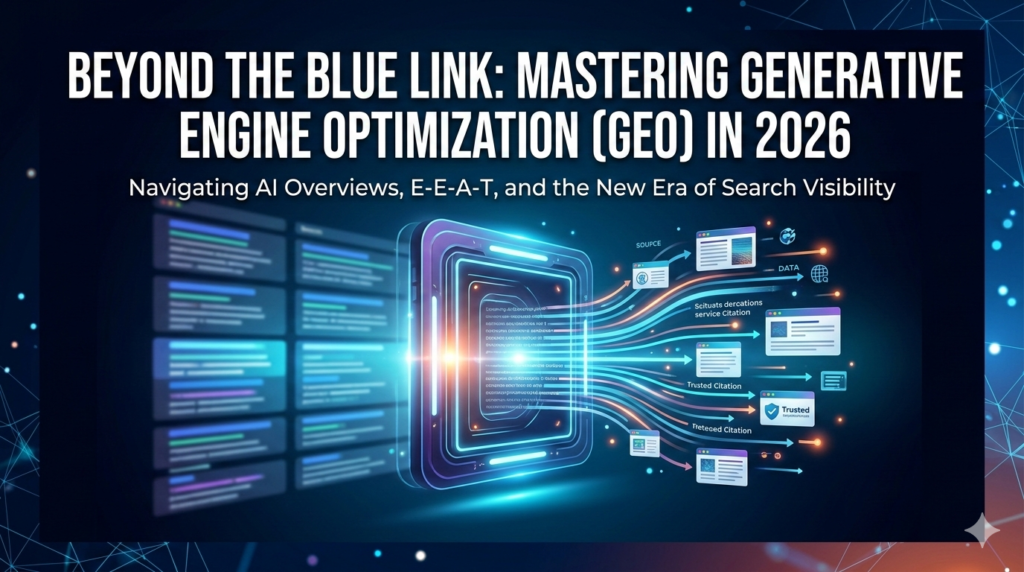
The search landscape has officially shifted. In 2026, ranking #1 on Google is no longer the ultimate prize. With the widespread adoption of Search Generative Experience (SGE) and AI-driven answer engines, the new goal is to become the cited source within an AI-generated summary. This evolution is known as Generative Engine Optimization (GEO).
If your content isn’t optimized for how Large Language Models (LLMs) “think,” your organic traffic could face a significant decline. Here is how to adapt your strategy to stay visible in the age of AI search.
What is Generative Engine Optimization (GEO)?
Generative Engine Optimization is the practice of optimizing content to be included in the responses generated by AI search engines. Unlike traditional SEO, which focuses on keywords and backlinks to rank a URL, GEO focuses on entity clarity, factual density, and structured context.
Key GEO Statistics for 2026:
- Zero-Click Searches: Over 60% of informational queries are now resolved directly on the SERP via AI Overviews.
- Conversion Impact: AI-referred traffic has shown to convert at 4.4x the rate of traditional organic search because the AI has already “vetted” the source for the user.
3 Core Pillars of a Modern GEO Strategy
1. The “Answer-First” Content Structure
AI engines prioritize “extractability.” To be cited, your content must provide direct, unambiguous answers.
- The 50-Word Rule: Start your articles or key sections with a 40–60 word “definition block” that directly answers the primary intent.
- Modular Formatting: Use H2 and H3 tags as questions (e.g., “What is GEO?”). Follow them immediately with a concise paragraph.
2. High Factual Density and E-E-A-T
In 2026, Google’s E-E-A-T (Experience, Expertise, Authoritativeness, and Trustworthiness) is the primary filter against “AI-generated fluff.”
- Unique Insights: AI models rarely cite content that simply rehashes existing data. You must include original research, case studies, or first-hand “Experience” (the extra ‘E’).
- Author Entities: Ensure every piece of content is linked to a verified expert with a robust digital footprint (LinkedIn, Schema-verified bio, and third-party mentions).
3. Advanced Schema and Technical Context
LLMs love structure. Beyond basic Organization schema, you should implement:
- FAQ Schema: To help AI engines map out your Q&A content.
- FactCheck Schema: To verify specific claims or statistics within your articles.
- SameAs Property: Connect your brand to existing entities in the Knowledge Graph.
Keyword Strategy: From Strings to Entities
Traditional keyword density is dead; entity density is the new metric. Instead of repeating “best SEO tools” 15 times, focus on covering the semantic cloud around the topic. For example, a high-performing GEO article about “Cloud 3.0” should naturally include related entities like sovereign cloud, low-latency inference, and AI-native architecture.
| Feature | Traditional SEO (2020-2024) | GEO (2026+) |
| Primary Goal | Rank #1–3 in Blue Links | Cited as a Source in AI Summary |
| Content Focus | Keyword Frequency | Factual Density & Intent Match |
| Link Building | Quantity of Backlinks | Brand Mentions & Citations |
| User Journey | Click -> Read -> Convert | AI Answer -> Trust -> Branded Search |