Many businesses make the mistake of focusing only on the number of backlinks they have.
In reality, Google cares far more about the quality of backlinks than the quantity.
One strong backlink from a trusted website can provide more SEO value than hundreds of low-quality links from unrelated websites.
This is why modern SEO is all about earning relevant, trustworthy, and natural backlinks that genuinely help users.
In this guide, we will explain the factors that make a backlink valuable and how you can identify links that actually improve rankings.
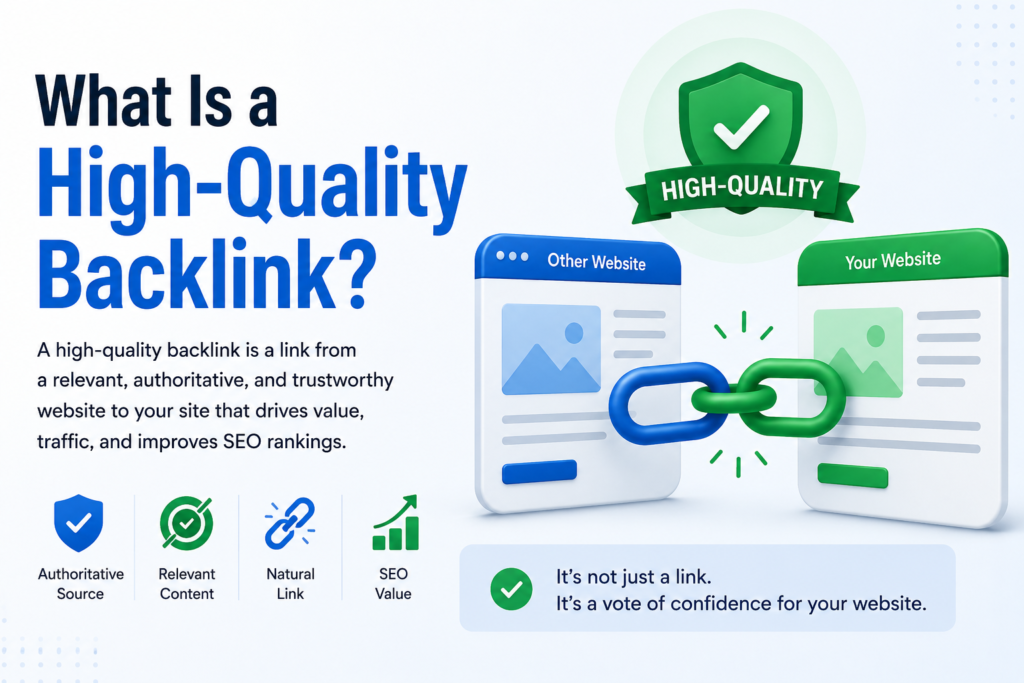
What Is a High-Quality Backlink?
A high-quality backlink is a link that comes from a trusted, relevant, and authoritative website and provides value to users.
Search engines treat these backlinks as recommendations.
The stronger the recommendation, the more likely Google is to trust your website and improve your rankings.
Why Backlink Quality Matters More Than Quantity
Years ago, websites could rank simply by building thousands of backlinks.
Today, search engines are much smarter.
Google now evaluates:
- Website relevance
- Authority
- Link placement
- User value
- Content quality
Because of this, websites with fewer but stronger backlinks often outrank websites with thousands of spam links.
1. Relevance of the Linking Website
Relevance is one of the biggest ranking factors for backlinks.
If you run an SEO website, links from marketing, technology, business, and digital marketing websites are far more valuable than links from unrelated industries.
Example
Good backlink:
- Marketing blog → SEO website
Weak backlink:
- Pet blog → SEO website
The closer the topic match, the stronger the signal.
2. Authority of the Website
Backlinks from trusted and established websites usually carry more value.
Search engines trust websites that have:
- Strong backlink profiles
- Quality content
- Good user engagement
- Industry credibility
A backlink from an established industry publication can have a much bigger impact than dozens of links from small unknown websites.
3. Contextual Placement
Where your backlink appears matters.
Links placed naturally inside the content of an article usually perform better than links found in:
- Footers
- Sidebars
- Author bios
- Widgets
Search engines consider contextual links more useful because they are part of the actual discussion.
4. Relevant Anchor Text
Anchor text is the clickable text used in a hyperlink.
For example:
- Link building guide
- SEO tools
- Digital marketing strategies
Good anchor text helps search engines understand the topic of the linked page.
However, using the same keyword repeatedly can look unnatural.
A healthy backlink profile includes:
- Brand anchors
- Partial match anchors
- Generic anchors
- Naked URLs
5. Traffic on the Referring Website
Many people ignore this factor.
A backlink from a website with real visitors often provides more value than a link from a website that receives no traffic.
Traffic-generating backlinks can provide:
- Referral visitors
- Brand exposure
- Leads
- Sales opportunities
SEO value and business value often go together.
6. Content Quality of the Linking Page
Search engines evaluate not only the website but also the specific page where your backlink appears.
A backlink inside a detailed, informative article is generally stronger than a backlink placed on a thin or low-quality page.
Always ask yourself:
“Would this page still be useful if search engines did not exist?”
If the answer is yes, the backlink is probably valuable.
7. Editorial Nature of the Link
Editorial backlinks are links given voluntarily by website owners because they find your content useful.
These are among the strongest backlinks in SEO.
Examples include:
- Industry references
- Research citations
- Expert mentions
- Case study references
Search engines trust editorial links because they are difficult to manipulate.
8. Link Position on the Page
Links placed higher within the main content often receive more attention from users.
For example:
- Introduction section
- Main body content
- Important discussion points
Links hidden at the bottom of pages generally carry less value.
9. Indexation Status
If Google cannot index the page containing your backlink, the SEO value may be limited.
Before building links, check whether:
- The page is indexed.
- The website is regularly crawled.
- Search engines can access the content.
An unindexed backlink cannot pass much value.
10. Natural Link Acquisition
The best backlinks are earned naturally.
Search engines prefer links that exist because:
- Your content is useful.
- Your research is valuable.
- Your business provides expertise.
- Your brand is trusted.
Artificial link patterns are easier for algorithms to detect.
Signs of a Low-Quality Backlink
Some backlinks provide little value and may even create risk.
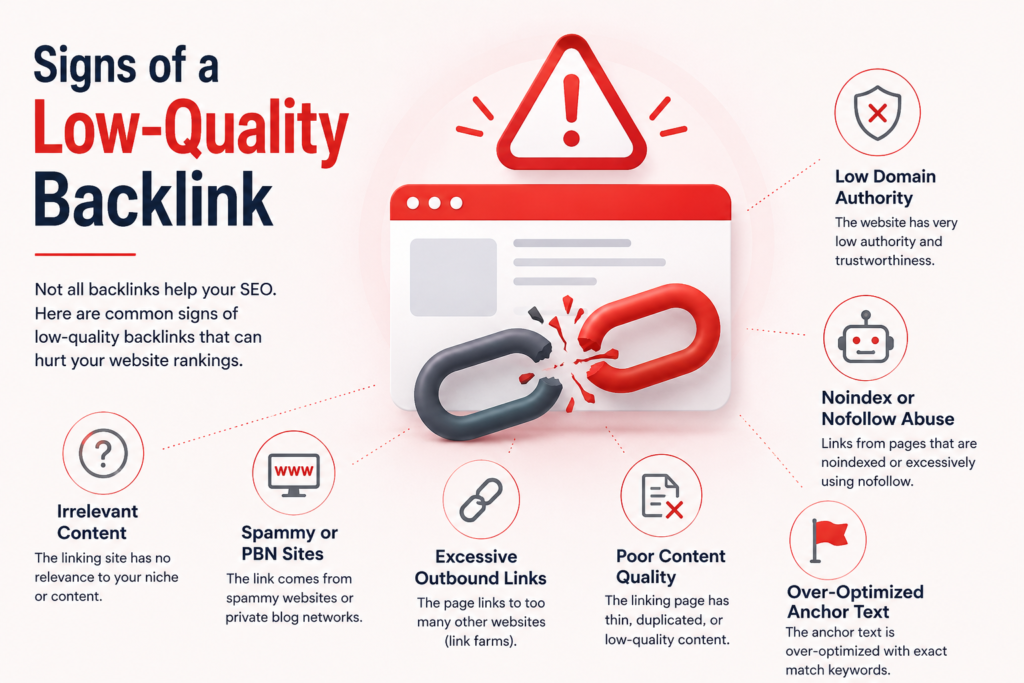
Be careful with links from:
- Link farms
- Spam directories
- Irrelevant websites
- Automated tools
- Low-quality PBNs
- Pages with hundreds of outbound links
These backlinks rarely help long-term rankings.
How to Build High-Quality Backlinks
Some effective methods include:
Guest Posting
Publishing useful content on relevant websites.
Digital PR
Earning mentions from journalists and industry publications.
Original Research
Unique data often attracts natural links.
Statistics Content
People frequently link to statistics and industry data.
Case Studies
Detailed case studies attract both readers and backlinks.
Linkable Assets
Tools, calculators, templates, and checklists often earn links naturally.
Are High Authority Metrics Enough?
Many people focus only on domain metrics.
Metrics such as:
- Domain Rating (DR)
- Domain Authority (DA)
- Trust Flow (TF)
can be useful, but they should not be the only factor.
A highly relevant website with moderate authority can sometimes provide more value than a high-metric website from an unrelated niche.
Relevance almost always wins.
How Backlink Providers Helps Businesses Build Quality Backlinks
At Backlink Providers, we focus on acquiring backlinks that meet modern SEO standards.
Our approach prioritizes:
- Niche relevance
- Authority websites
- Contextual placements
- Natural anchor text
- Long-term SEO growth
Our services include guest posting, niche edits, digital PR, and authority link building designed to improve rankings safely and sustainably.
Final Thoughts
The definition of a quality backlink has changed significantly over the years.
Today, the best backlinks are those that provide value to users, come from relevant websites, and fit naturally within useful content.
Instead of asking, “How many backlinks do I need?”
Ask:
“How many high-quality backlinks can I earn?”
That mindset usually produces better rankings, stronger authority, and sustainable SEO growth.
Frequently Asked Questions
What is considered a high-quality backlink?
A high-quality backlink comes from a relevant, trustworthy, and authoritative website and is placed naturally within useful content.
Is one quality backlink better than many low-quality backlinks?
Yes. One strong backlink can often provide more SEO value than dozens of weak backlinks.
Does website relevance matter for backlinks?
Yes. Relevant backlinks usually pass stronger ranking signals than links from unrelated industries.
Are contextual backlinks better?
Yes. Links placed naturally inside content generally perform better than sidebar or footer links.
Can spam backlinks hurt rankings?
Yes. Low-quality and manipulative backlinks may reduce trust and create SEO risks.
Are guest post backlinks still effective in 2026?
Yes. Guest posting remains one of the most effective methods for earning quality backlinks when done on relevant websites.
Should I only focus on high DR websites?
No. Relevance, traffic, and content quality are often more important than DR alone.
How does Backlink Providers help businesses acquire quality backlinks?
Backlink Providers offers guest posting, digital PR, niche edits, and authority link-building services focused on long-term SEO growth.